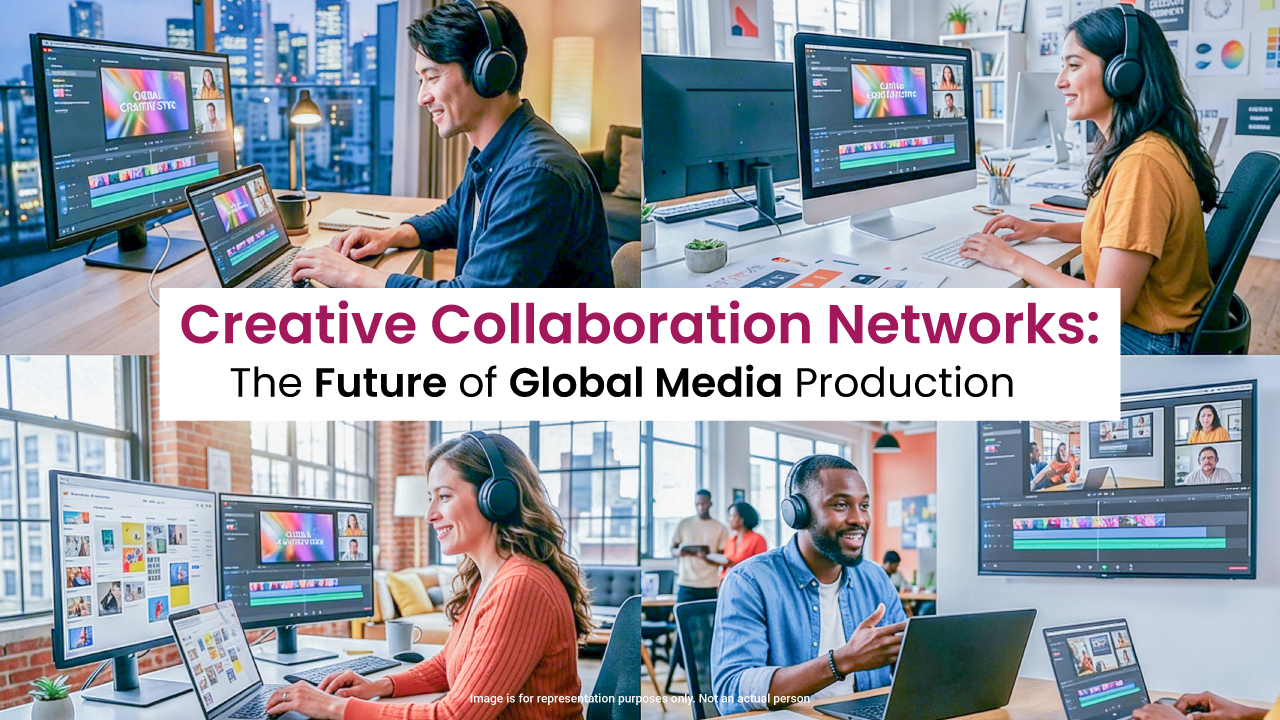
Creating media once required being near its production hubs. Authors collaborated in editorial rooms, designers worked within studio walls, and manufacturers gathered in centralized offices, where ideas moved through strict hierarchies. Access to opportunities depended on physical location, and collaboration was limited by geography, institutional entry points, and organizational barriers.
The system was effective until the world evolved.
With the growth of digital tools and increased connectivity, something was changing. An artist in a region on the planet could collaborate with a global writer thousands of miles away. A film-maker may work with editors, musicians, and illustrators regardless of time zones. What used to require physical presence now just requires aligning on the vision.
Initially, these were single cases - experiments in distant cooperation. But over time, they evolved to become much more than that.
What Are Creative Collaboration Networks?
These networks do not merely constitute distributed teams. They are living ecosystems of individuals with various cultural, professional, and creative backgrounds who come together to create media. Collaboration networks are dynamic, versatile, and self-focused, unlike the conventional production models, which are rigid, centralized, and goal-oriented.
In this new model, there is no single organization where creativity is isolated; it flows across borders.
An idea in one place can become a story through the visual interpretation of that story in another place, and ultimately be polished with cultural knowledge of the story in another place. Every participant takes an individual approach, enriching the end product in ways that would not have been possible in a closed system.
This change is transforming the way media is produced, consumed, and distributed. One of the greatest benefits of creative collaboration networks is diversity of thought. The narratives become more detailed, accommodating, and universal when artists in another cultural context work on the same project. Narratives cease to exist in a single perspective and instead indicate the complexity of the world they portray.
This is especially necessary in a time when the audience is no longer restricted by particular geographies. The current media can move across continents within seconds. An article produced in one country can appeal to audiences in another, provided it is authentic and culturally sensitive.
This is enabled through collaboration networks. They enable the media to be influenced by various voices until it reaches a global audience. There is no need to retrofit content to suit various markets, as they are built with different perspectives in mind.
Technology Driving Global Media Collaboration
It is important to note that technology is the key to this change. Cloud computing applications, real-time communication, and online workflow in production enable creators to work harmoniously across distances. However, it is not these networks that are characterized by technology.
Trust is what really keeps them going. Unlike conventional organizations with well-established hierarchies, collaboration networks are based on mutual respect and shared ownership. Contributors should have confidence in each other in terms of knowledge and artistic instincts, and conviction in the common vision. In its absence, distributed collaboration will easily fragment.
Something extraordinary occurs with it, however, i.e., creativity accelerates! The evolution of ideas is faster because they are influenced by multiple inputs simultaneously. Feedback loops are activated. Innovation does not occur as an individual phenomenon but is a group phenomenon.
The role of leadership in media production is also altered in this model. Rather than dictating all project actions, leaders in collaboration networks serve as facilitators. They provide space for ideas to emerge naturally, guide the creative process without dictating it, and ensure it does not suppress individuality.
In this regard, leadership would be less authority-based and more of an orchestration.
Far-Reaching Effects of this Transformation
To creators, collaboration networks make opportunities available worldwide. Talent is no longer tied to geography or institutions. Independent creators can work on projects across continents, building portfolios of diverse experiences.
To the audience, it creates more authentic media. Narratives harbour meanings that are decoded through cultural lenses. Images, stories, and attitudes are closer to the rest of the world, in which viewers are more integrated.
And, more broadly, in the media industry, collaboration networks will signal a shift towards more participative and flexible production frameworks. They undermine established gatekeeping institutions and develop ways for emerging voices to be involved in crafting cultural discourses.
Nonetheless, this change needs to be designed as well.
Building Effective & Culturally Sensitive Collaboration Networks
There is no such thing as creative collaboration occurring automatically simply because tools are present. It should be cultivated through effective communication, values, and systems that facilitate coordination without restricting creativity. Effective networks are organized and flexible enough to enable those contributing to them to develop ideas, yet they remain consistent in the end product.
Cultural sensitivity is also paramount to them. The collaboration between people with diverse backgrounds will be crucial to understanding and appreciating different points of view. This not only improves the quality of work but also makes media more ethical and more authentic for the audience.
As the world becomes more connected, creative collaboration networks are poised to take on the form of media production infrastructure worldwide. They are an indication of a larger transformation of isolated creation to collective creativity, centralized control to distributed innovation.
In this changing environment, companies that know how to develop and maintain such networks will define the future of media.
Sumangali Media: Driving the Change
Sumangali Media explores the possibilities of distributed creativity by creating environments where creators, storytellers, and thinkers can work across boundaries. It does not view media as a solitary activity but as a group phenomenon of multitone voices.
Our platform motivates contributors to engage in valuable collaboration by emphasizing narrative, community building, and open systems of creativity. It acknowledges that strong stories are created when diverse views come into contact and when imagination is given free rein across boundaries.
By so doing, Sumangali Media is not just creating content- we aim to aid the creation of networks that will shape the future of media worldwide. Since the next generation of storytelling will not be developed in isolation, it will be created together.