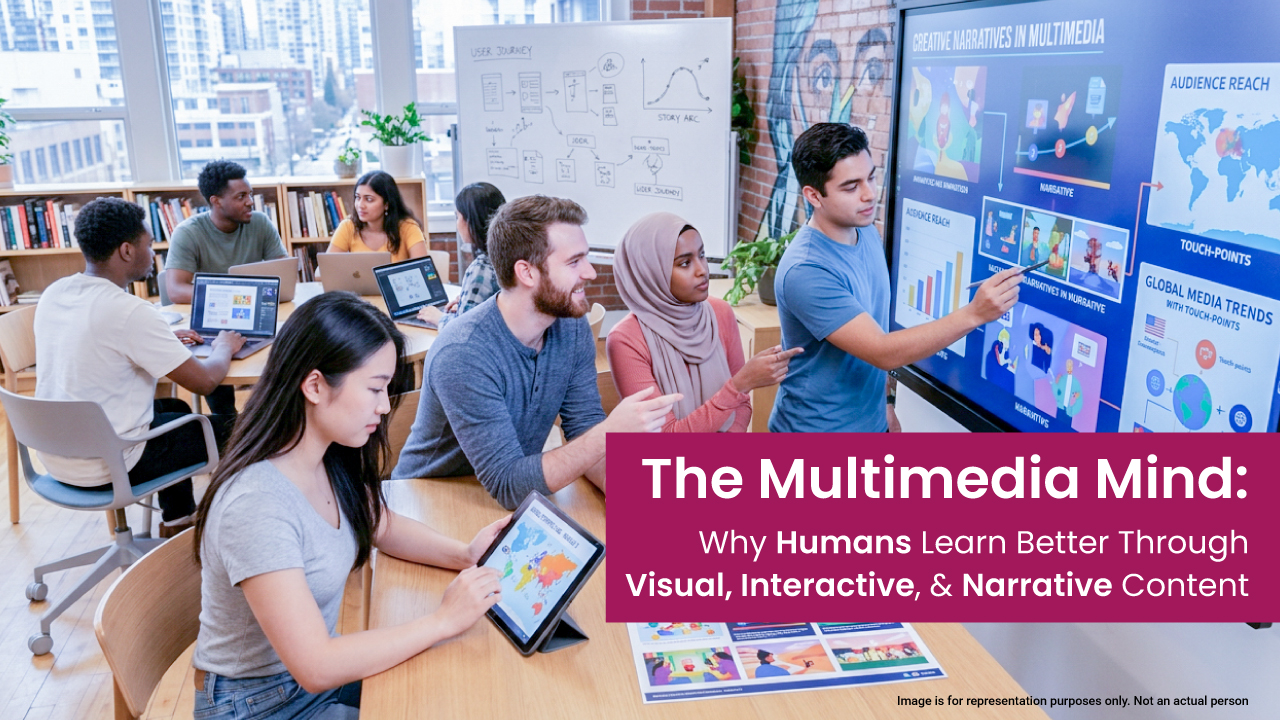
In a quiet classroom, a student turns a page. The book is full of detailed, well-organized information. But after a while, it’s hard to stay focused. Eyes move over the words, but the mind starts to drift.
Now, picture something different. Instead of only reading, you see a bright image and a moving, colorful idea. The concept is part of a story, making it feel real and relatable. A question asks you to join in, so you stop, think, and answer. In this way, you don’t just read the idea; you experience and interact with it.
It is not the content's complexity in the difference; it depends on how it is received by the mind.
The Evolution of Human Learning: From Oral Tradition to Multimedia
The way human minds think has never been designed to process information in a single format. Even before the written language was invented, people perceived the world in the form of images, patterns, and narratives. The exchange of knowledge was carried out by oral communication, visual images, and experience. Education was experiential, interpersonal, and closely tied to emotion.
The new digital age is not creating new modes of learning in many ways. In fact, it is regaining the way human beings have always learned well.
Such a fact is captured in the notion of the multimedia mind. It leads to the assumption that information is better processed by the brain when both sensory and thought pathways are activated simultaneously. Images, interactive interactions, and plots collaborate to produce more knowledge and sustained knowledge.
Such visual information as the visual material is processed much faster than textual information. Patterns, colors, and relationships that are almost instantaneously identified by the brain. An effective visual is more than just information in a bottle, but it gets to the point and finds relationships that would require paragraphs and paragraphs to define. Complex concepts can be made available not by reducing depth, but by increasing clarity.
However, images are not sufficient.
Active Learning: The Role of Engagement in Knowledge Retention
Engagement converts passive learning into active learning. Individuals are no longer observers when they interact with content, respond to prompts, explore, or make decisions. This change reinforces memory, since the brain is no longer a passive recipient of information; it is actively engaged in working with it.
Recent educational research supports this shift. Studies show that when learners actively participate, whether through discussion, hands-on activities, or digital interaction, they retain more information and develop a deeper understanding. Active engagement also boosts motivation, making learners more likely to seek out knowledge and apply it in real-world contexts.
Involvement is formed through interaction, and participation leads to knowledge.
Next, there is a narrative that holds it all together.
The Importance of Storytelling in Education
There is structure and meaning in stories. They convert abstract ideas into familiar experiences. A good story puts information into context, enabling the mind to memorize and systematize it. Learners do not encounter isolated facts; they see ideas as part of the greater adventure.
It is why individuals tend to remember stories much longer than they recall data. Stories refer to emotion, and emotion builds memory.
Learning can be multidimensional when the visual, interactive, and narrative elements are combined to create a learning process. The brain establishes connections between various areas- visual processing, language understanding, emotional reaction, and decision-making. These associations provide more robust neural networks, thus knowledge becomes easier to access and use.
Single-format learning, in turn, often struggles to reach the same level. Text in itself may inform, it may not necessarily engage. But, unlike encouraging exploration, static images can demonstrate. Information may be disjointed without a narrative.
Multimedia learning fills these gaps.
How Multimedia Learning Bridges Educational Gaps
It concurs with the functioning of attention in the contemporary world. With the environment full of stimuli, the mind needs something that is interesting, significant, and easy to digest. The need is met by multimedia experiences without loss of depth. They enable the learners to shift freely between observation, interaction, and reflection.
Additionally, multimedia learning supports the development of essential 21st-century skills. By allowing learners to engage with content in different ways, these experiences cultivate adaptability, digital literacy, and creative problem-solving. As the world continues to change rapidly, the ability to learn flexibly and think critically is more valuable than ever.
Critically, this style also favours a range of learning styles.
Some people perceive best with pictures. Others through stories. Others by active participation. Multimedia materials accommodate such varied differences, so more individuals can identify with the learning process.
Breaking Language Barriers: The Global Reach of Multimedia Education
This inclusiveness comes in very handy, especially in international settings. As digital platforms reach diverse cultures and backgrounds, the need to express ideas effectively arises. There are visual and narrative solutions that can be used to overcome language barriers, and an interactive format that allows participation without prior need.
The outcome is a more approachable, interactive way of learning, in which a person does not merely provide information but also encourages discovery.
Yet, effective multimedia experiences are not made by chance.
Combining visuals, interaction, and storytelling cannot be done randomly. Every component has to play a role. Art should explain, rather than confuse. Communication must enhance comprehension, not hinder it. Learning should be guided by narratives, not shadowed by content.
Transforming Learning into Lasting Experiences
Multimedia learning is not just a process; when well planned, it becomes an experience.
An experience that is engaging, keeps one interested, and prompts reflection. Something that reflects the natural process by which individuals interact in the world, such as seeing, doing, and feeling.
This approach mirrors real-life learning, in which discovery occurs through active participation and emotional connection. When learners are engaged on multiple levels, intellectually, emotionally, and physically, they are more likely to retain information and apply it beyond the classroom. These meaningful experiences lay the foundation for lifelong curiosity and growth.
The multimedia mind will continue to grow as education and media evolve. It is not about gaining access to information anymore, but about the opportunity to meaningfully interact with it. In this new environment, platforms that know how to create such experiences will determine the future of learning.
This is where Sumangali Media comes in, making contributions to the evolution.
Sumangali Media: Pioneering Multimedia Learning Solutions
The combination of visual storytelling, interactive formats, and story-driven content makes Sumangali Media treat learning as a whole experience rather than a fixed process. It is not just informative but also entertaining, as it aims not only to inform the audience but also to engage them in thinking, reflecting, and even participating.
The platform acknowledges that knowledge is more effective when it is felt through creative media, considered design, and community-driven storytelling. It adopts the concept of learning as a two-way relationship rather than a one-directional relationship, a dynamic between content and audience.
By doing so, Sumangali Media will be in harmony with the multimedia mind cycles. The future of learning will not be information-based. It will be constructed on experiences that individuals can view, touch, and recall.