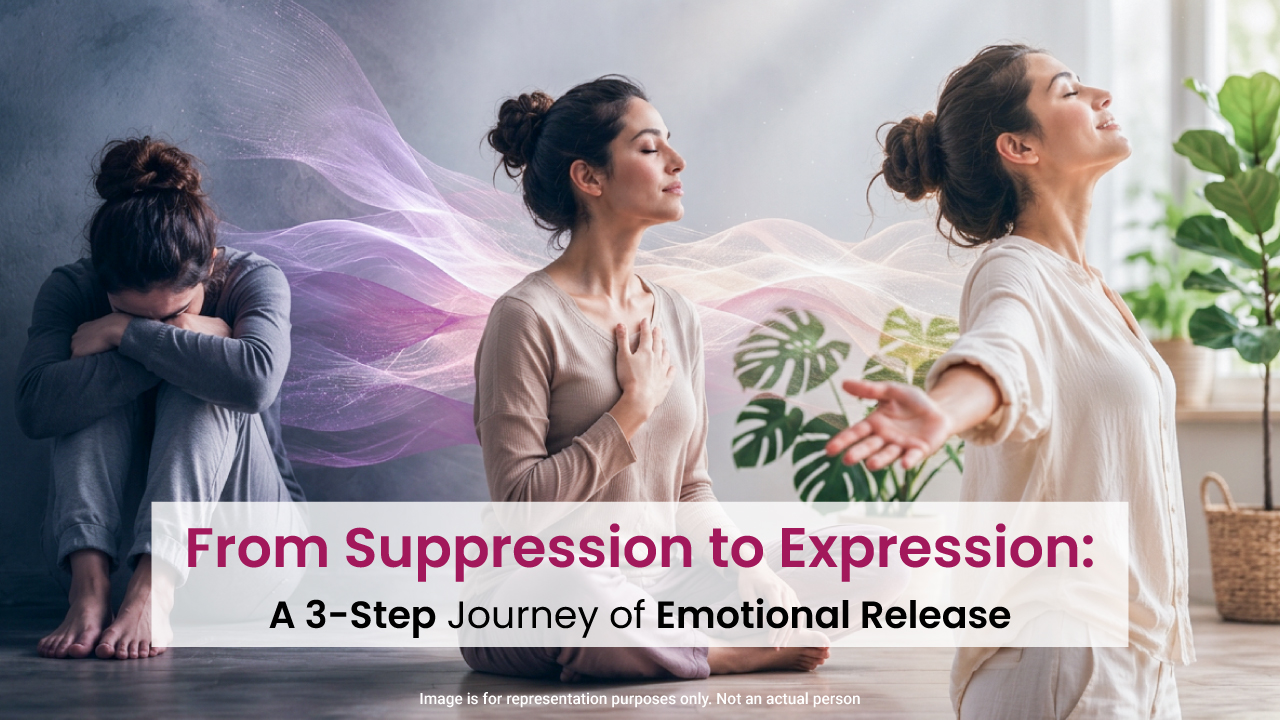
Most of us have a silent fact we coexist with but seldom challenge.
We were never really taught how to feel.
We were taught how to behave, how to respond, and how to hold it together.
But what becomes of all that we do not say?
It does not disappear.
It lies down in the body, in patterns, in lapses between who we are and who we might be. With time, repression becomes habitual. and custom breeds identity.
The process of suppression of expression is not dramatic. It is not loud. It is delicate, multi-layered, and very human.
And it begins with awareness.
Step 1: Awareness: Listening to What the Body Already Knows
Before expression comes recognition.
Most people try to fix emotions without ever fully noticing them. But emotions are not problems to solve. They are signals to understand:
-
A tight chest before a difficult conversation.
-
A heaviness in the shoulders at the end of the day.
-
Restlessness without a clear reason.
These are not just arbitrary feelings. They speak out of the body.
One practice that helps with listening is awareness.
Not analyzing, but being present.
When we start noticing without evaluating, something changes. We pass out of unconscious reaction to conscious observation.
And therein the change is conceived.
Step 2: Expression: Giving Emotion a Way Out
What is not expressed does not resolve. It accumulates.
Expression is not about performance.
It is about permission.
Permission to move.
To experience uncensored. To let the body complete what it has been holding onto.
To others, expression appears as movement.
To others, it can be breath, motionlessness, or sound.
But most fundamentally, expression is a discharge. It enables the emotions to flow in the body rather than remain stagnant. And as emotions change, they change.
That is why the purely verbal processing may leave much to be desired. Emotion can be described in words, but it cannot always be discharged.
The body, however, can.
Step 3: Transformation: Reaction to Integration
After expressing emotions, something noticeable occurs. They lose their intensity, and their grip softens.
What once felt overwhelming becomes understandable.
What once felt stuck begins to flow.
Transformation has nothing to do with being someone that you are not. It is all about going back to a more stable, earthly version of yourself.
At this phase, feelings are no longer in control of you.
They are telling you.
You begin to respond instead of react.
To choose instead of repeat.
And slowly, patterns that once felt automatic begin to shift.
Beyond the Experience: Enter the BET Model
Although this journey can be intuitive, real change requires organization.
This is not done by chance at Sumangali Media. It is thoroughly planned, fine-tuned, and presented in the BET Model, an acronym for Body, Emotions, Thoughts.
BET Model is not just a model.
It is a directed journey that unites movement, emotional awareness, and integrative practices into an integrated experience.
It does not provide individual methods but a sequence:
-
Body: Development of awareness using somatic practices.
-
Emotions: Facilitating safe, authentic expressions.
-
Thoughts: Applying knowledge to life.
The BET Model is unique in the sense that it unites art and therapy. It does not isolate the analytical and the experiential. It brings them together. In Body of Emotions, participants are not taught about emotional wellbeing.
They live it.
They experience what it means to feel without fear.
To express without judgment.
To transform without force.
This is where workshops become journeys.
And journeys become shifts that stay.
An Invitation
If you have ever felt like you understand your emotions, but still feel stuck.
If you have ever tried to move on but found yourself returning to the same patterns.
It might not be about trying harder. It could have something to do with having a different experience. The journey from suppression to expression is not something you have to navigate alone.
Sumangali Media invites you to a place where your body is not heard but listened to through the BET Model.
Where you are not controlling your emotions, but perceiving.
Where change is not imposed but is natural.
This is not just a workshop.
It is a beginning.
A return.
A release.
A reimagining of what it means to feel truly.
And perhaps, the first step is simply this
Choosing to begin.