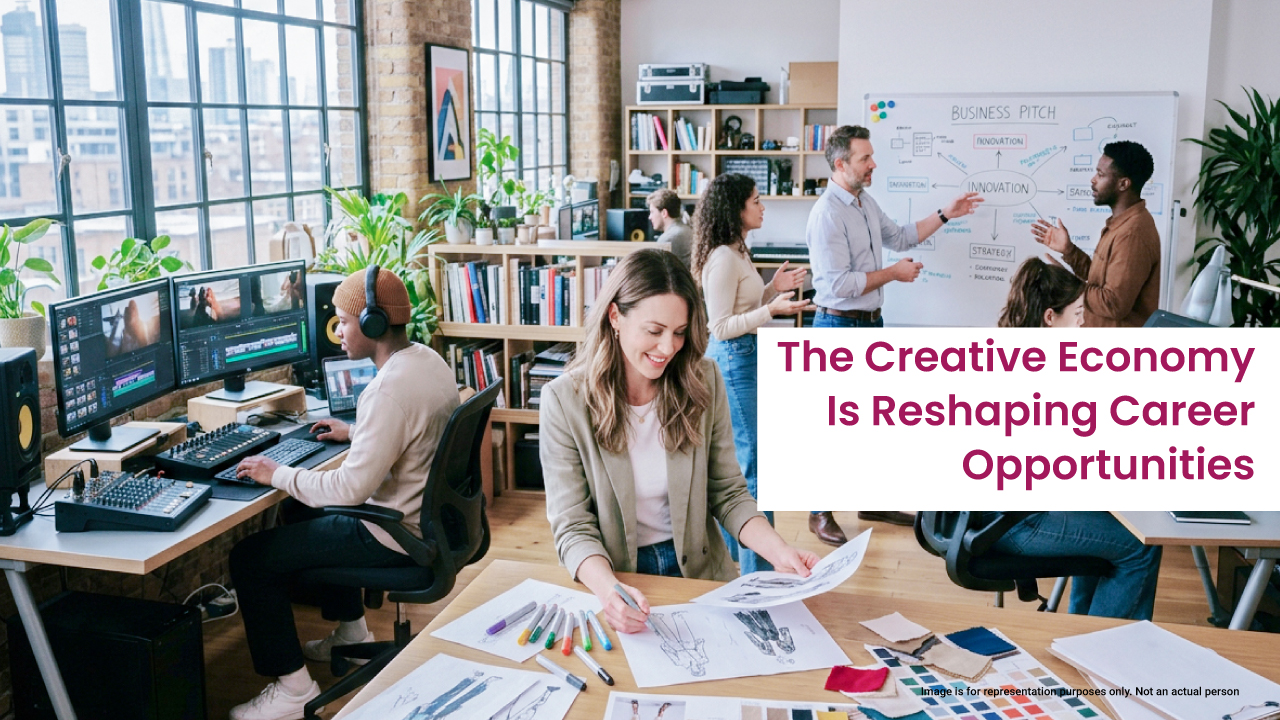
For decades, career success was closely associated with traditional professions such as engineering, medicine, finance, manufacturing, and government services. While these fields continue to play an important role, the global economy is undergoing a significant transformation. Creativity is no longer confined to the arts or entertainment. It has become a powerful economic driver, creating new industries, redefining existing professions, and expanding career opportunities across every sector.
The creative economy is built on ideas, culture, innovation, intellectual property, and human imagination. It encompasses industries such as media, design, advertising, performing arts, film, music, publishing, gaming, digital content, architecture, fashion, cultural tourism, creative technology, and many emerging fields powered by digital platforms.
Creative professionals are in greater demand than ever as organizations compete by innovating, rather than just on size. People who have the technical skills and are creative, communicative, culturally savvy, and innovative will be valued in the future of work.
Why the Creative Economy Is Driving Workforce Growth
The nature of work has evolved beyond producing goods and delivering services. Today's economy increasingly values experiences, storytelling, design, originality, and human-centered innovation. Businesses are looking for professionals who can solve problems creatively, engage audiences, build meaningful brands, and create products that connect emotionally with customers.
This shift has expanded career opportunities far beyond traditional creative professions.
User experiences are enhanced through redesigning and user interaction with designers and engineers. Content makers collaborate with teachers to enhance learning. Artists contribute to health, urban development, and the wellbeing of the community. Digital Storytellers help businesses convey complex concepts. Creative strategists shape marketing, product development, and organizational culture.
The creative economy won't replace traditional industries. However, it is redefining them by adding creativity as a competitive edge.
As more and more organizations realize that innovation is more than just technical expertise, they are increasingly seeking ideas from a wide range of people and perspectives, as well as from interdisciplinary teams. Therefore, the demand for professionals with analytical and creative skills has surged across various industries.
New Career Pathways Are Emerging Across Industries
Technology has lowered barriers to participation in the creative economy. Individuals can now build careers as independent creators, consultants, educators, designers, filmmakers, podcasters, digital artists, cultural entrepreneurs, experience designers, community builders, and creative technologists.
At the same time, traditional organizations are creating entirely new roles focused on customer experience, digital storytelling, innovation management, community engagement, creative strategy, sustainability communication, and cultural transformation.
The advent of remote work, digitization, creator ecosystems, and international collaborations has also broadened professional opportunities to work across industries and the globe.
Today's young working professionals have no idea what is expected of them in their jobs. Many are developing a portfolio career, one that includes several skills, industries, and creative pursuits throughout their career.
This change fosters a culture of lifelong learning, entrepreneurship, and adaptation, which are essential traits for the future workforce.
Creativity Is Becoming an Economic Capability
The creative economy is frequently thought of as the domain of artists and performers. The truth is, it is driven by professionals who generate value through ideas, innovation, communication, design, and cultural understanding.
Every organization now benefits from creative capability.
Designers are essential for healthcare organizations to enhance patient experiences. The companies depend on creative engineers to design new and original products. Engaging learning designers are necessary at educational institutions. Technology firms spend vast amounts of money on user experience, storytelling, and product design. Creative communication is a central skill that nonprofits use to inspire participation and mobilize communities.
Unique human attributes will take on greater importance as AI takes over repetitive and predictable tasks. As AI takes over repetitive and predictable tasks, uniquely human attributes will become increasingly valuable. Creativity allows professionals to spot opportunities, question assumptions, think differently, and develop solutions that technology cannot develop.
This not only boosts creativity as an art form but also as an economic tool to support business growth, innovation, entrepreneurship, and workforce resilience.
The world of work of the future will be characterized increasingly not by the industrial sector in which workers are engaged, but by the creativity of those workers.
Building a Workforce That Thrives in the Creative Economy
Education for the creative economy must be based on a more comprehensive view of workforce development. Technical education remains critical but must always be complemented by communication skills, collaboration, creative confidence, cultural awareness, entrepreneurship, and lifelong learning.
Designing environments that foster creativity is a role for all of us, whether we are involved in an educational institution, a business, a cultural organization, or a community. Individuals gain adaptability skills from a range of viewpoints, interprofessional working, artistic experiences, community engagement, and problem-solving, preparing them for future careers.
The workforce of the future will no longer be just people seeking jobs. It will feature creators, innovators, collaborators, entrepreneurs, and community leaders who are constantly creating new opportunities rather than waiting for them to come.
As the creative economy grows, investing in people's creativity will be one of the most essential investments for society.
How Sumangali Media Is Championing the Creative Economy
At Sumangali Media, we see the creative economy as more than a collection of industries. It is a movement that recognizes creativity, culture, and human expression as powerful contributors to economic and social progress. We believe that stories, ideas, artistic practice, and cultural participation are not peripheral to development. They are central to shaping the future of work and opportunity.
Sumangali Media tells original stories, creates culturally enriching and artistic experiences, encourages community dialogue and discussion, and provides a space for the voices of different creatives. We provide a place for artists, educators, creators, cultural practitioners, and changemakers to share ideas, learn from each other, and join in on discussions about the changing landscape of work.
The creative economy should be thought of not only as a job-creating sector but also as one that has other impacts on a community: culture, innovation, and opportunities for future generations. Sumangali Media's focus on the synergy among creativity, culture, and workforce development underscores the need to shift perceptions and attitudes towards creative jobs, ensuring they are seen not as a societal alternative to conventional employment but as a vital contributor to inclusive growth, economic resilience, and human progress.