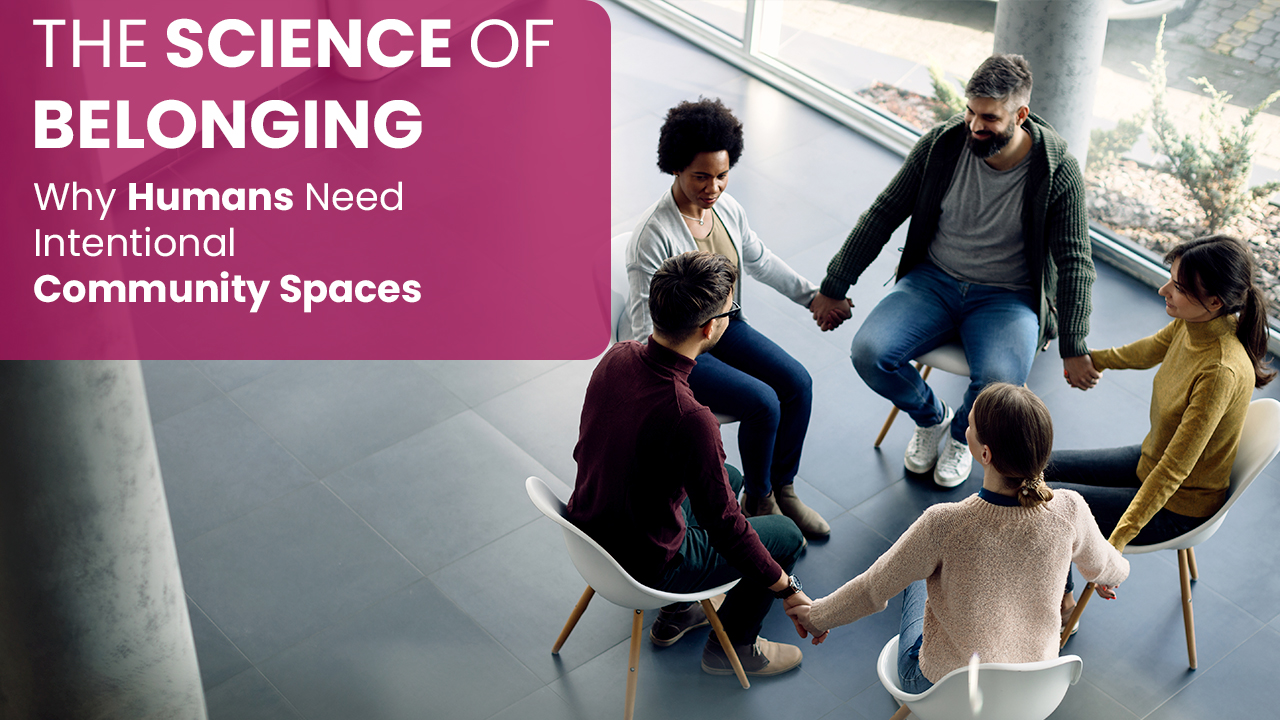
The room was simple, in an urban environment with noise, traffic, and an open floor plan, with soft music playing. It was commonplace, with no significant signs or delicate ornamentation. Still, people kept coming in. With notebooks, weary workers, sketchbooks, scarves, sketchbook dancers, notebook students, elderly members in search of companionship, newcomers in search of something familiar, and everyone turned up, each hoping, without making noise, to find some point of contact.
One evening, a small group of people was seated there. They discussed one of the simplest questions: What does belonging feel like? Individuals were sitting in a circle, telling their stories about their culture, childhood, art that had enabled them, and music that made them feel not alone. The room was filled with a silent sense of protection, warmth, and empathy as they conversed.
They did not even know that what they were experiencing at that time was called neuroscience.
The Neuroscience of Belonging & Human Connection
When individuals feel secure, empathized with, and appreciated, the body produces oxytocin, the bonding hormone that fosters emotional trust. Studies have consistently shown that belonging is not a luxury; it is a biological need.
We need community just as we need food, shelter, and rest.
At the time when people feel like belonging:
- Stress levels decrease.
- Emotional strength is enhanced.
- Creativity expands.
- Learning becomes easier.
- Identity becomes stronger.
- Loneliness fades.
- Empathy deepens.
That is why the power of purposefully formed community spaces is so strong. They make us use the senses of our brains that seek meaning, expression, and mutual experiences. The meeting room was not exceptional due to the walls. It was unique since it provided a connection. It made strangers know themselves in one another.
Why Intentional Community Spaces Are Essential for Social Well-Being
Over the weeks, individuals continued to attend various events, such as discussions, physical and art classes, and cultural gatherings. One thing became evident with the course of time:
Belonging does not occur automatically. It is constructed knowingly, thoughtfully, and with feeling. In modern-day life, it is the one that makes connecting more difficult. People travel a lot, work from home, reside in remote cities, and are unable to preserve their cultural identity. Although the world is becoming smaller, loneliness is increasing.
Deliberate community spaces help recover what society has been gradually losing. These spaces are successful as they provide:
Emotional Safety in Community Spaces
A place where humanity should be allowed to be, where openness is accepted and encouraged.
Shared Rituals and Storytelling in Building Community
Rituals, art, music, and stories have been key to life in human cultures throughout history.
Multisensory Learning and Creative Expression in Community
Different sections of the brain are stimulated by movement, music, talking, art, and group activities, and are more likely to form better emotional memories.
Affirming Identity Through Community Involvement
Being with others who have the same experience makes people feel more grounded and understand themselves better.
Collective Healing Through Community Support
Community spaces can help people ease transitions, reduce stress, address cultural displacement, and ease emotional burdens.
Opportunities for Contribution & Participation in Community Spaces
Belonging does not only concern receiving. It is also about making something matter and knowing it counts.
Each session, whether through words, movement, music, silence, or simply being present together, reminded people that connection is an essential human need, not something to be thankful for.
How Human Connection Develops in Community Spaces
One of the creative sessions on the concept of home involved having participants express their ideas however they wished, through movement, color, gestures, words, or sound. Others employed little gestures of everyday life. Other people spoke of the comfort of old food, the beat of celebrations, or the coziness of childhood lullabies.
It was not a right-or-wrong expression; it was an authentic experience. The whole group saw themselves in each contribution as each person gave theirs. It turned out that belonging was not about everybody being similar. It is regarding the glory of our diversity. We are free to be ourselves without fear and yet feel part of the whole.
The Contribution of Sumangali Media in the Creation of Spaces of Belonging
Sumangali Media helps build opportunities to belong, be creative, and form emotional attachments. Our organization unites cultural learning, art, and togetherness in profound ways through three primary areas, namely, Content Services, Community & Events, and Community Spaces.
It promotes self-expression through its arts programs, workshops, and meetups, and promotes a supportive, creative space that makes everybody feel supported and encouraged.
The digital and visual experiences provided by Sumangali Media enable people to access them without being tied to physical space; hence, learning, culture, and community can accompany them wherever they go.
With the increasing loneliness and disconnection in the world, we at Sumangali Media present something valuable: a home where people can connect, be creative, find identity, and belong through art, learning, and community.
FAQs
Belonging is the feeling of being accepted, valued, and understood in a group. It allows individuals to express themselves freely and feel emotionally safe and connected.
Belonging reduces stress, enhances emotional resilience, and supports mental health by fulfilling a basic human need for connection.
These are environments designed to foster meaningful interaction, inclusion, and shared experiences through empathy and participation.
Creative activities encourage self-expression and shared experiences, helping individuals connect on a deeper emotional level.
Sumangali Media uses storytelling, arts, workshops, and digital platforms to create inclusive environments where people feel safe, connected, and empowered.